ISLAMABAD: In the face of mounting criticism from opposition parties with regard to transparency in the July 25 polls, the Election Commission of Pakistan (ECP) on Thursday asked the government for constitution of a panel of experts to probe the failure of result management system within four weeks and fix the responsibility as well.

On behalf of the Election Commission, Director Elections Ch Nadeem Qasim wrote a letter, in this context, to the Cabinet Division secretary with the subject: Inquiry of result management system during the conduct of polls on July 25 and afterwards.

“You are hereby directed in terms of Article 202 with Article 218 (3) of the Constitution of Islamic Republic of Pakistan to constitute an inquiry committee consisting of technical experts from the National Telecommunication and Information Technology Security Board and Pakistan Telecommunication Authority,” says the letter.

The terms of reference of the inquiry include: to analyse the concept of RTS in terms of its ‘implementation’, to analyse the project of RTS as envisaged by the Election Commission; to analyse the preparation and finalisation of RTS project by the National Database and Registration Authority; to analyse the quality and extent of training imparted to various users under the projects; to analyse the chain of events taking place on the night of July 25 andafterwards, to fix responsibility in terms of all these factors and make recommendations for future course of action.

The Election Commission said that the inquiry must be concluded within four weeks and if required, an expert opinion may also be utilised after due permission of the Election Commission.

Already, the election commission has written to the provincial election commissioners, district returning officers and returning officers to furnish report as to why there was delay in results. Joint opposition alleges that polling agents were not allowed during counting and there was an alleged deliberate attempt to delay announcement of results.

Meanwhile, the election commission spokesperson reacted strongly to a statement by PPP senior leader and candidate from NA-259, Mir Baz Khetran, that the ECP secretary interfered and rigged polls in the constituency. He vehemently rejected this statement and said that through such baseless and unfounded statements, facts could not be hidden.

He emphasised that according to initial results from NA-259, Khetran was clearly far behind and turned out to be at number three at the time of final results. He called on the PPP leader to desist from such baseless statements and accept the voters’ decision.

ISLAMABAD: The Election Commission of Pakistan (ECP) is set to void polls, and their results, in two national assembly constituencies over low turnout of female voters.

“A summary has been moved to the Commission by the ECP secretariat recommending that the polls in NA-10 (Shangla) and NA-48 (North Waziristan) — where women votes were less than 10 per cent of the total polled votes — be declared void,” a source in the ECP told Dawn on Thursday.

Read: Thari women set example for all with nearly 73% turnout in 2018 elections

The number of registered voters in a constituency includes both men and women who have registered to vote. The 10pc law was passed to ensure that women participated in the polls, and were not marginalised or coerced into not voting. According to the rules, if among the total votes cast in a constituency, the share of women in the final count is less than 10pc, the results of the polls may be declared void.


Shangla NA seat was won by PML-N candidate while an independent candidate clinched North Waziristan seat


In NA-10 (Shangla) the total number of registered voters is 374,343. Out of the 212,294 male voters, 115,639 (54 pc) cast their votes while only 12,663 women from the total registered 162,049 female voters turned up to vote. The total votes cast in the constituency was 128,302 and the 12,663 female votes was less than 10pc of the total votes.

Ibadullah Khan of Pakistan Muslim League-Nawaz had won the seat by clinching 34,070 votes in a closely contested battle with Saeed ur Rahman of the Awami National Party who bagged 32,665 votes. It was one of 44 constituencies where the number of rejected votes was higher than the margin of victory.

In NA-48 (Tribal Area) the total number of registered voters was 274,205. Out of the 196,668 male voters, 57,600 (29.28 pc) and out of a total 77,537 female voters just 6,364 (8.19 pc) turned up to vote. Women voters fell short of just 32 votes to attain the 10pc share in the total polled votes. The seat was won by Mohsin Javed — an independent — by securing 16,496 votes defeating the PTI’s Aurangzeb Khan who managed 10,369.

There were many other constituencies where the turnout for women voters remained low, but above the yardstick of 10pc of the total vote. In NA-44 (Tribal area), out of the total 114,261 female voters, just 10,849 voted. The total number of registered voters in the constituency was 265,217, which included 150,956 men — 59,295 (37.29pc) of them voted.

Likewise, in NA-49 (Tribal area VIII) out of the total 81,207 registered female voters, merely 12,001 women turned up to vote. In NA-50 (Tribal area IX) just 7,513 of the total 44,865 registered female voters exercised their right to vote. In NA-33 (Hangu), out of the total 118,650 women voters 22,001 cast their votes.

In NA-268 (Chaghai) out of the total 99,613 women voters, 20,606 voted. Surprisingly, the female turnout in terms of percentages — relative to the total registered votes — was higher than the men. Out of the total 134,678 male registered voters in the constituency just 27,618 (20.65pc) polled their votes.

In as many as 18 constituencies, the women voters’ turnout was higher in terms of percentage against male voters. In NA-271 (Tharparkar i) 72.83pc of the total registered voters cast their votes. The proportion of male voters in the constituency was 65.39 percent. NA-222 (Tharparkar II) was similar — with a positive that this was the only constituency where over seventy percent of the voters, both male and female, exercised their right to vote. 71.40pc of the registered female voters and 70.51pc of the male voters cast their votes. In NA-56 (Attock) 63.03pc of the women polled their votes compared to 62.19pc male voters. In NA-186 (Muzaffargarh VI) 61.85pc women and 58.85pc men polled their votes. In NA-1 (Chitral) 61.57pc female and 60.49pc male voters exercised their vote.

In NA-64 (Chakwal I) 60.72pc women and 55.67pc men turned up to vote. Other constituencies where women voter turnout was higher than the men included NA-46, NA-58, NA-65, NA-66, NA-67, NA-68, NA-70, NA-71, NA-72, NA-74, NA-76, and NA-77.

Still however — overall — there were many constituencies where women represented less than one-third of the total votes cast that showcases that we are from inclusive elections in the country.

Polling is underway at a polling station  for two National and Sindh assemblies constituencies  in Dadu district of Sindh where a clash between rivals had led to postponement of election    on July 25.

Police and army personnel have been deployed to ensure security at the polling station 62 that has been set up in Government Girls School.

There are 1226 registered women voters at the polling station.

According to Geo News, Pakistan People’s Party candidate Irfan Zafar had lead of more than 15000 votes while Fayaz Butt of the same party had lead of 1800 votes.

ISLAMABAD: It was all going smoothly till 11:47pm on July 25. The results after daylong polling were pouring in with the expected pace simultaneously at the Election Commission of Pakistan (ECP), the offices of the returning officers (ROs) and the state-run Pakistan Television through the newly-developed state-of-the-art Result Transmission System (RTS), when all of a sudden, the whole process came to a standstill.

As the flow of results stopped abruptly, there was confusion everywhere with no one knowing where exactly the problem was. This was the time when the political parties, which had already been crying foul over the alleged forcible expulsion of their political agents from polling stations during vote count, began expressing their suspicion over the counting process.

Analysis: Perceptions of election rigging

And then ECP Secretary Babar Yaqoob Fateh Mohammad appeared on TV screens well after midnight just to inform the nation that the RTS had “collapsed”. He announced that the ECP was returning to the traditional method of manually tabulating the results and, therefore, there could be an inordinate delay in the release of unofficial results.

Investigation reveals presiding officers were instructed to stop using RTS though it had never crashed

This was what the nation saw on the screens.

Behind the scene, senior and top officials of the National Database and Registration Authority (Nadra) — the creators of the RTS mobile app — were protesting with the ECP for, what they called, making a “wrong announcement” since the RTS was “fully functional” even after the controversial news conference of the ECP secretary.

Computer log

The Nadra officials also produced the “computer log” to the secretary showing normal transmission of the results through the system. But they were simply told by the ECP officials that they had decided to stop using the RTS because it had started “malfunctioning”.

“It was in the best national interest and to avoid any further controversy” that Nadra preferred not to react over the secretary’s presser,” sources in Nadra said.

They told Dawn that if the Nadra officials had reacted over the controversial announcement of the ECP secretary, it could have aggravated the already tense political situation and the media might have played it up as a confrontation between the two institutions.

The sources said at about 11:47pm, the presiding officers and the ROs were informed over the phone through the provincial election commissioners that they should stop using the RTS “as a problem has occurred” in the system.

The sources said Nadra officials did not know the reason for all this faux pas, but they believed that perhaps it was the ECP’s own costly Result Management System (RMS) that had stopped functioning and the ECP had put the blame on Nadra only as a cover-up. They said that RTS and RMS were independent systems and there was no integration between the two.

Nadra got nearly 50pc results through RTS

In all, the sources said, the ECP and Nadra were to receive over 170,000 results (Forms 45) of the national and provincial assembly constituencies directly from over 85,000 polling stations. Nadra had received over 84,000 of them (nearly 50 per cent) through the RTS, they added.

Take a look: ‘The parties’ claims over Form-45 have put a question mark on the elections’

Claiming that the RTS had never crashed, the sources said Nadra did not have the remaining results, because the presiding officers after receiving instructions from the ECP authorities stopped using the RTS. They said the presiding officers were also given instructions to travel to the RO offices for tabulation of results.

The sources said Nadra officials were upset over the development, because Nadra had developed this system and provided this additional support to the ECP under an agreement with the commission in February 2018. As “the RTS has no mention in the Elections Act, 2017”, it had nothing to do with the official announcement of the results by the ECP, the sources explained. The system, the sources said, was only meant for the quick announcement of the results for the media through the ECP and that was why its link had been provided to PTV as well.

Nadra hiding its own weaknesses: ECP

A spokesman for the ECP Nadeem Qasim refuted the Nadra’s claim that RMS might have failed on the election night, reiterating the stance that the RTS had crashed. He alleged that Nadra was making these claims only to hide its own “weaknesses”.

Mr Qasim explained that under the plan, the presiding officers were in any case required to reach the RO offices under the “security cover” even after sending the results through the RTS to physically submit Forms 45. However, he said, after the “collapse” of the RTS, the presiding officers simultaneously reached the RO offices and it took longer than the required time to enter the data of each polling station.

When his attention was drawn towards the Nadra’s claim that it possessed nearly 50pc results which it had received through the RTS, Mr Qasim said: “There’s no use of making claim of having such a data seven days after the results.”

He said the ECP wanted the RTS to produce results within a few hours after completion of the polling process as there was no use of the RTS otherwise. He also refuted the Nadra’s claim that the RTS had no mention in the Elections Act.

Responding to a question, the spokesman said the ECP would welcome any kind of inquiry into the matter as there must be “fact-finding” to end the controversy.

When contacted, a spokesman for Nadra refused to give any official reaction, terming it a sensitive matter. “I can neither deny nor confirm,” said the spokesman when his comments were sought on the situation.

Parliamentary commission demanded

The political parties, including the PPP and the PML-N, have already agreed in principle to demand the formation of a parliamentary commission to probe poll rigging charges.

Talking to Dawn, PPP secretary general Farhatullah Babar said traditionally polls day manipulation took place in the RO offices at the time of consolidation of results and the RTS had been introduced to reduce the role of the ROs.

“The RTS worked perfectly well on election day for some hours until someone was scared by the prospects of eliminating the role of ROs altogether and decided to discontinue it,” he alleged, while calling for a “forensic audit” to find answers to a number of questions.

“Did the RTS actually collapse, at what time and what caused the collapse? If it did not actually collapse who in the ECP decided to stop the RTS by declaring it was malfunctioning and on whose instructions he did so?” Mr Babar went on saying.

“Just call the officers of the ECP and Nadra before the parliamentary committee in an open public hearing and all pieces of the jigsaw puzzle will fall into place,” he added.

RTS and RMS

The RMS is offline software installed in a computer at RO office that also has a trained data entry operator. The RO receives results from presiding officers on Form 45, mostly hard copies and the operator enters results in RMS. When results from all the polling stations have been received, RMS is instructed to generate Form 47 which is consolidated result of that constituency. This Form is then faxed to the ECP that uploads it on its website.

However, the RTS is an entirely different system meant to transmit Form 45 from polling stations to RO offices and the ECP Secretariat using a smartphone and around 170,000 POs and other officials had been trained in the month of July to use this mobile app.

Section 13 of the Elections Act states: “the Commission shall establish a transparent results management system for expeditious counting, tabulation, compilation, transmission, dissemination and publication of results in the official gazette and on the website of the Commission.”

It further says: “The PO shall immediately take snapshot of the result of the count and, as soon as connectivity is available and it is practicable, electronically send it to the Commission and the RO before sending the original documents under Section 90.”

LAHORE: The Pakistan Tehreek-i-Insaf has entered the `final phase’ of forming its government in Punjab with assertions that the party has already got the support of required number of MPAs-elect. However, there is no discussion on the selection of a candidate for Punjab chief minister for now.

Besides eight elected members of Pakistan Muslim League-Quaid (PML-Q), including an independent, the PTI claims 22 independents have formally joined the party, taking its tally to 153 in the directly-elected house of 297 members.

The 22 independents, who have joined the party, are: Raja Sagheer Ahmad (PP-7), Syed Saeedul Hassan (PP-46), Muhammad Ajmal Cheema (PP-97), Ghulam Rasool Sangha (PP-83), Ameer M Khan (PP-89), Saeed Akbar Khan (PP-90), Khawar Shah (PP-203), Muhammad Umer Farooq (PP-106), Faisal Hayat (PP-125), Hussain Jahanian Gardezi (PP-204), Sheikh Salman Naeem (PP-2017), Fida Hussain (PP-237), Shaukat Lalika (PP-238), Sardar Abdul Haye Dasti (PP-270), Basit Bukhari (PP-272), Khurram Leghari (PP-275), Tahir Mehmood Randhawa (PP-282), Syed Rafaqat Ali Gillani (PP-284), Muhammad Hanif Pitafi (PP-289), Taimoor Laali (PP-93), Rai Taimoor Bhatti (PP-124) and Mehr Aslam Bharwana (PP-127).

Sources say the PTI will bag 34 women seats and five minority seats against its 153 members and show up with 192 members in the complete house of 371 members.

Sources say party chairman Imran Khan on Wednesday remained busy in discussions about party policies for the first 30 days, 90 days and 100 days. “However, there was no discussion on the chief minister candidate as the party is weighing all options,” says a party leader.

Owing to indecision, the candidates for the coveted chief minister slot are increasing and lobbying with their credentials besides discrediting others on different grounds.

Candidates in the run are: Abdul Aleem Khan, Dr Yasmin Rashid, Fawad Chaudhry, Mian Aslam Iqbal, Mian Mahmoodur Rasheed and new entrant Yassir Humayun (PP-21).

PESHAWAR: The Election Commission of Pakistan (ECP) has asked the women and minorities candidates to be elected on reserved seats to submit details of election expenses before August 4 as to be notified as members of the assemblies.

The Provincial Election Commissioner asked the Pakistan Tehreek-e-Insaf (PTI) 14 candidates to submit details of their election expenses. The PTI 14 women candidates, who are set to become MPAs received notice from the Provincial Election Commissioner, who is also returning officer for submission of the details of election expenses.

Those who received the notices are Nadia Sher, Maliha Ali Asghar, Aisha Naeem, Momina Basit, Dr Sumera Shams, Rabia Basri, Dr Asia Asad, Sajida Haneef, Somi Falak Naz, Ayesha Khushnood, Sitara Afreen, Zeenat Bibi, Asia Khattak and Maria Fatima. Momina Basit, who is at serial number four in the priority list of women reserved seats in the KP Assembly, told The News that she had received notice and would submit details of election expenses before August 4 to the Provincial Election Commission.

The PTI had submitted the priority list of 15 female candidates for the 22 seats reserved for women in KP Assembly. Among those in that list, 14 candidates were declared qualified, whereas one of the women, Nadia Khattak, whose name was at Serial No 15, had not filed nomination papers. Similarly, the women MPAs and MNAs and minorities candidates to be elected MPAs and MNAs of all parties of the KP province were issued notice to submit details of polls expenses.

An EC official said that if the elected MPAs failed to submit details of election expenses before August 4, their parties would suffer in the number of seats in formation of the government as they would not be added to the number until notified by the ECP.

On the other hand, the Election Commission of Pakistan also changed the nomenclature of the post of Agency Election Commissioners to the District Election Commissioners after the merger of the tribal agencies in KP. As per the notification issued by the Chief Election Commissioner, it said the nomenclature of the post was changed in pursuance of the Board of Revenue and Estate department, government of Khyber Pakhtunkhwa notification issued on July 19 with immediate effect.

It said now Agency Election Commissioner, Khyber Agency, be called District Election Commissioners Khyber, and similarly the other tribal agencies.

With just over a month to go until the expiry of President Mamnoon Hussain’s tenure, the Election Commission (ECP) of Pakistan expects the next presidential election to face delays.

President Hussain’s five-year term is set to expire on September 9. According to the Constitution, the presidential election must be held at least a month prior to the expiry of the incumbent’s term, which in this case would be August 8, an ECP source told DawnNewsTV.

The president is elected by an electoral college comprising members of the Senate, National Assembly and four provincial assemblies. Voting is held through a secret ballot.

Ordinarily, the presidential election is held either a month after the General Election, or at least a month before the expiry of the president’s tenure.

However, since neither the National nor the provincial assemblies are functional as yet ─ and will likely not be up and running until at least August 10, holding a presidential election on August 8 will be nearly out of the question, the ECP source said.

Additionally, if the General and presidential elections fall in close proximity to each other, the Constitution requires that the presidential election be held a month after the General Election ─ which in this case would mean August 25.

Since the ECP is legally bound to issue a schedule for the presidential election at least 15 days in advance ─ Aug 10 in this case ─ the incomplete status of the electoral college means that a schedule is unlikely to be issued by this date, putting the Aug 25 date in jeopardy as well.

Therefore, the ECP source said, the commission would likely take cover of Article 254 and hold the election in early September.

Article 254 states:

Failure to comply with requirement as to time does not render an act invalid. When any act or thing is required by the Constitution to be done within a particular period and it is not done within that period, the doing of the act or thing shall not be invalid or otherwise ineffective by reason only that it was not done within that period.

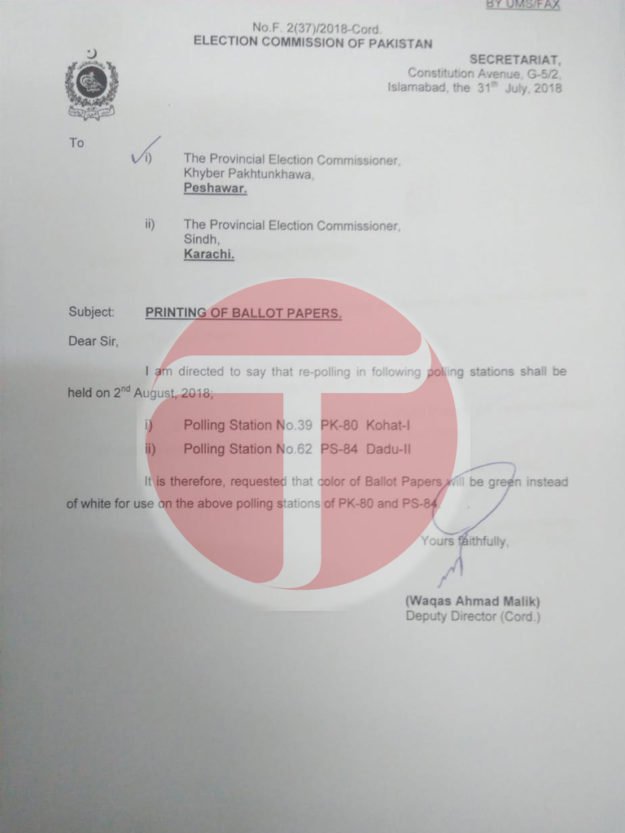
PESHAWAR: Days after general elections, the Election Commission of Pakistan (ECP) has ordered re-polling in two provincial assembly constituencies.

In a notification issued on Tuesday, the ECP announced holding re-elections in PK-80 (Kohat I) and PS-85 (Dadu II) in Sindh Assembly on August 2.

The commission had previously ordered recounts in around 70 constituencies on July 30 after dozens of candidates approached the ECP after their pleas were dismissed by returning officers. In some cases they complained unconsolidated results.

ECP orders recount in 70 constituencies

It is pertinent to note that the recounts will affect the final tally of MNAs and MPAs in the race for forming the government.

Once the recount process completes, results of all the constituencies are consolidated and winners submit their statements of election expenses, ECP would officially notify them as members of the respective assemblies.
After ECP’s official notification, there will be three days for independents to join any party, after which parties will be allocated reserved seats of women and non-Muslims proportionate to their final tally on directly elected seats.

ISLAMABAD: The Election Commission of Pakistan (ECP) Tuesday asked all the legislators-elect to submit details of their election expenses, as not a single one had so far met this legal requirement.

According to the ECP spokesperson, the lawmakers-elect in the July 25 elections were directed to file the details of their poll expenses to the concerned returning officers by August 04. Otherwise, the related notification pertaining to their poll win would not be issued. Similarly, the ECP also directed women and non-Muslims, whose names were in the final list of reserved seats i.e. Form 33, to submit the expense details to returning officers by August 07.

ISLAMABAD: All winning candidates in the recent general elections have been asked to submit their election expenses to the Returning Officers (RO) by the Election Commission of Pakistan (ECP) by August 4 for the issuance of official notification, a local media outlet reported.

“The ECP had invited the attention of returned candidates to the provision of 98 of the Election Act 2017 which inter alia provides that every returned candidate shall, within 10 days from the poll of an election, submit a return of the election expenses under section 134 and the commission shall not notify in the official gazette the result of a returned candidate who fails to submit his/her return of election expenses,” read the notification released on Monday.

All successful candidates must present their expenses within 10 days while unsuccessful candidates need to do so within 30 days after the elections. Constitutional requirements necessitate the formation of  government within 21 days after the elections.

ISLAMABAD: The Election Commission of Pakistan ordered recounting of votes in more than 70 constituencies of national and provincial assemblies during the past three days, a senior ECP official told Dawn on Monday.

He said that under the law, a recount could be allowed only before consolidation of results, adding that the orders had been issued only in the cases where consolidation process had either not started or not completed. He said that in the rest of the constituencies, the consolidation process had been completed and Form-49 tabulating consolidated results, including ballot papers, had been received by the commission.

The official said that under Section 95 (6) of the Elections Act, the commission might, before conclusion of the consolidation proceedings, for reasons to be recorded, direct the returning officer to recount the ballot papers of one or more polling stations. Under the law, he added, the returning officer was to complete the consolidation proceedings within five days of the recount.

Although the ECP has ordered recounting on more than 70 constituencies, the list officially shared with it includes 26 constituencies — 15 national and 11 provincial assemblies. The National Assembly constituencies include the two from where former prime ministers Shahid Khaqan Abbasi and Syed Yousuf Raza Gilani lost to Pakistan Tehreek-i-Insaf candidates — NA-57 (Rawalpindi) and NA-158 (Multan).

Official says recount can only be held where consolidation of results has either not started or not been completed.


Ballots for NA-129 (Lahore-VII), where former National Assembly speaker Ayaz Sadiq was declared victorious against PTI’s Aleem Khan, will also be recounted, while requests by his fellow PML-N ticket-holders — Baleeghur Rehman (NA-170, Bahawalpur-I), Rana Muhammad Hayat Khan (NA-140, Kasur-I), Rana Afzaal Hussain (NA-119, Sheikhupura-I) and Rana Mohammad Afzal (NA-110, Faisalabad-X) — have also been accepted.

Recounting has also been approved for six Punjab Assembly seats, three Khyber Pakhtunkhwa Assembly seats and two Sindh Assembly seats.

Meanwhile, recounting requests for 32 constituencies, where consolidated results had already been received, were rejected by the commission. These include NA-35 (Bannu), where PTI chief Imran Khan defeated former KP chief minister Akram Khan Durrani of the Muttahida Majlis-i-Amal. These also include requests of PTI’s Mian Manzoor Ahmad Watto (NA-144, Okara) and Begum Tehmina Daultana of the PML-N (NA-164, Vehari).

Recounting requests can be entertained at three levels — presiding officer (PO), returning officer (RO) and the ECP.

A presiding officer can order a recount at his/her polling station of his/her own motion or at the request of a candidate, the candidate’s election agent or a polling agent. According to Article 90 (6) of the Elections Act 2017, the presiding officer can order a recount once.

The returning officer, on the other hand, can order a recount right up till the process of consolidation starts, that is, right after the preliminary results are announced. The returning officer has to be provided a written request by a candidate or their election agent when the margin of victory is under five per cent of the votes polled or 10,000 votes, whichever is lesser. According to Article 95 (5) of Elections Act, the returning officer can order a recount on one or more of the polling stations under his watch at the same time, unless he thinks the request is unreasonable. The law is silent on what should form the basis for declaring a request ‘unreasonable’ practically, leaving it at discretion of the returning officer.

The ECP can order a recount before completion of the consolidation process, which means before the postal ballots have been counted and Form-49 filled out.

ISLAMABAD: The Pakis­tan Tehreek-i-Insaf (PTI), led by PM-in-waiting Imran Khan, has secured around four million more votes than its arch-rival Pakistan Muslim League-Nawaz (PML-N) in the elections to the National Assembly, as the PTI’s vote bank has registered an over twofold increase when compared to the results of 2013 elections.

As the PTI makes efforts to form a government in the Centre for the first time, the statistics released by the Election Commission of Pakistan (ECP) show that its votes increased from 7.67 million in 2013 to 16.85 million in 2018.

While the PTI rose from the second to the top position in the chart of party-wise vote bank, the case with PML-N was reverse — as it lost around two million votes in this election. The PML-N had secured 14.87 million votes in 2013 polls when the total number of registered voters was 86.18 million. Five years later the total number of registered voters reached 105 million, yet the PML-N’s share in the vote bank shrank to 12.89 million.

According to ECP data, PPP retains vote bank; MMA gets 2.5m votes, TLP with 2.19m votes emerges as fifth largest political party


However, the Pakistan Peoples Party continues to retain the third position, with no major change in its vote bank. The total number of votes it bagged in 2013 polls was 6.91 million that decreased to 6.90 million in 2018.

The independents had secured 5.88 million votes in the previous general election and this time they got more than six million votes.

The Muttahida Majlis-i-Amal (MMA), an alliance of politico-religious parties, secured 2.54 million votes from across the country.

The Tehreek-i-Labbaik Pakistan (TLP) — a new entrant in electoral politics — emerged as the fifth biggest political party in the country by securing more votes than any party other than the PTI, PML-N, PPP and MMA. The TLP bagged 2.19 million votes, holding a lead of nearly one million votes over the Grand Demo­cratic Alliance (GDA) that bagged 1.25 million votes.

In 2013, the MMA did not exist and the parties comprising the conglomerate had contested the election then individually. The same was the case for the TLP.

Each of the three other parties — Awami National Party (ANP), the Muttahida Qaumi Movement (MQM-P) and PML-Q — secured between half million and one million votes.

The MQM, which had secured 2.35 million votes in the previous elections, managed to get 0.729 million votes. The ANP got 0.808 million votes, while the Chaudhry Shujaat Hussain-led PML-Q, which had formed the government in the Centre in 2002 election, could manage to get a little over half a million votes this time.

The Balochistan Awami Party (BAP) received around 317,000 votes followed by Balochistan National Party (BNP) which got around 215,000 votes.

Six other parties that clinched more than one hundred thousand votes were namely Allah-o-Akbar Tehreek (AAT) that provided a platform to the Milli Muslim League — the political face of banned Jamaatud Dawa — to contest elections, Sindh United Party (SUP), Pakhtunkhwa Milli Awami Party (PkMAP), Pak Sarzameen Party (PSP), Sheikh Rashid-led Awami Muslim League (AML) and Jamshed Dasti-led Pakistan Awami Raaj (PAR).

The PML-Functional bagged 72,461 votes, Tehreek-i-Labaik Islam (TLI) 57,267 votes and Qaumi Watan Party (QWP) got 55,722 votes.

The Pakistan Rah-i-Haq Party (PRP), which had awarded a party ticket to chief of the banned outfit Ahle Sunnat Wal Jamaat (ASWJ) Maulana Ahmad Ludhianvi in the previous polls, received 55,184 voters, while Mir Israrullah Zehri’s BNP (Awami) secured 52,970 votes.

APML gets 36,489 votes

Retired General Pervez Musharraf-led All Pakistan Muslim League (APML) managed to get 36,489 votes from across the country.

The National Party (NP) received 33,102 votes, Maulana Samiul Haq’s faction of Jamiat Ulema-i-Islam (JUI-S) secured 24,559 votes, and the Jamiat Ulema Pakistan (Noorani) got 22,904 votes.

Former lawmaker Ayesha Gulalai-led PTI faction (PTI-G) received 4,130 votes.

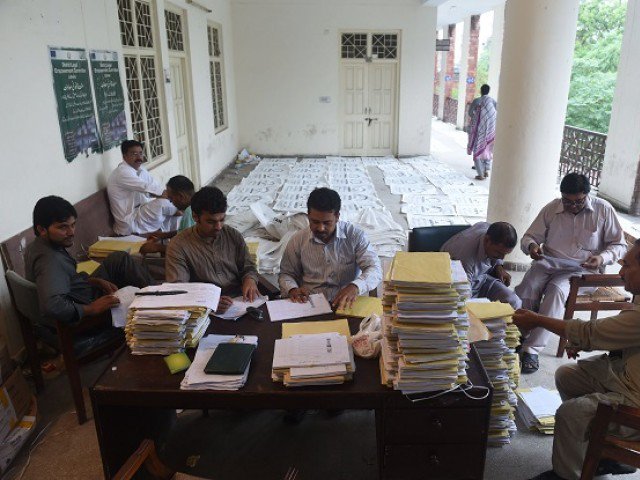
ISLAMABAD: The Election Commission of Pakistan (ECP) will upload over 83,000 Forms-45 on its website by Tuesday for which it has asked its officials to collect documents from across Pakistan.

A senior official at the Election Commission told The News that they expected to ‘put on display’ the Form-45 on the commission’s website by Tuesday. This is being seen as a bid to put at rest speculations about transparency of the electoral exercise.

The Form-45, also called the statement of the count, is a document which contains candidate’s data as well as vote count. The returning officers and polling staff are supposed to stamp and thumbprint it for authenticity and record.

Political parties alleged that their polling agents at polling stations were not provided with copies of Form-45 and alleged in certain cases their polling agents were asked to leave.

ISLAMABAD: Election Commission of Pakistan (ECP) secretary Babar Yaqoob Fateh Mohammad has conceded the failure of the result transmission system (RTS), saying it did not work as expected.

“It is a lesson that technologies should not be introduced before multiple tests. We will see how it can be improved,” he said at a press briefing here on Thursday.

He, however, said the RTS had significance with regard to sharing of information, but it had no legal value.

Secretary says announcement of results took 50 hours in 2008 and
days in many constituencies in 2013


About delay in announcement of results, he recalled that the announcement of results took 50 hours in 2008 and it took days in many constituencies in 2013.

He said 90 per cent of results had so far been announced in the field, out of which the ECP had received around 82pc results and he was expecting 95pc results by Friday. He said the results received so far indicated that the voters turnout was over 55pc.

Claiming that the polls had been conducted in a free and fair manner, he said no serious rigging complaint had been received including the allegations of stuffing of ballot boxes and bogus vote casting. He said the complaints were procedural in nature.

About a video that went viral on social media showing a woman stamping multiple ballots, he said it was an old video. He said the colour of ballot papers used this time was green but the one showed in the video was dark in colour.

The ECP secretary said results from polling stations could not reach returning off­i­cers in time due to bad wea­ther and security threats.

PESHAWAR/SAHIWAL: In a historic first, women in some conservative parts of Khyber Pakhtunkhwa and Punjab came out of their homes to cast their votes in the general election on Wednesday as candidates sought to fulfil the legal requirement of minimum 10 per cent women’s turnout to validate their result.

In Balochistan, too, women came out in large numbers to vote despite terror attacks and repeated threats.

Women in tribal areas and other conservative areas had been barred from voting in the past general elections, as the practice of keeping women from voting is a norm under verbal and written agreements bet­ween candidates and family elders in such areas.

However, for the first time in the country’s electoral history, the Election Commission of Pakistan (ECP) annulled the result of Dir Lower (PK-95) by-polls in 2015 after finding that none of the registered women voters had cast votes.

The Elections Act requires the ECP to declare an election null and void if women’s turnout in a constituency is less than 10pc of its total polled votes.

On Wednesday, candidates and local administration on ECP directives ensured at least 10pc turnout of women voters in the districts notorious for barring women from voting. The measures encouraged women voters not only in Khyber Pakhtunkhwa’s Dir Lower but also in a village of Punjab’s Sahiwal district to visit their respective polling stations and cast their vote.

“Since the 1990s we had not seen women coming out in large numbers,” said Zahid, a local journalist in Dir.

“I voted for the first time. My mother, aunt and cousins also went out today to vote,” said a cheerful Shafi Naz from Dir Lower while speaking to Dawn. She wanted to go to vote during the previous elections also, but the family elders did not like women to leave their homes. Surprisingly, she said, nobody objected to their going out to vote. However, she was not aware of the fact that Election Act required 10pc women vote to acknowledge result of a constituency.

In North Waziristan, Bajaur and other far-flung parts of Mohmand tribal agency also saw a rise in female voters’ turnout despite lack of facilities and slow polling process.

Considering past voting trends in the conservative parts of Khyber Pakhtunkhwa, the ECP had issued directives to district returning officers and deputy commissioners to ensure women’s voting in six districts namely Swat, Dir Lower, Dir Upper, Shangla, Swabi and Batagram.

Punjab

Women of Jahan Khan Village (111/9-L) in the National Assembly constituency of Sahiwal (NA-147) also created history by voting for the first time in any general election for which the administration, civil society organisations and media could be credited.

There are 4,022 registered voters in the village and out of them 1,822 are women.

The village is divided among Jahan Khan, Shadookay and Kubaykay localities out of which Jahan Khan is the most populated. The Joiya biradri dominates the village.

Deputy commissioner Mohammad Zaman Wattoo told Dawn that a special session had been arranged to train women to vote by the polling staff. He said if the media had not highlighted lack of women’s participation in elections, this year too they would not have voted in the village.

District Election Commissioner Rana Ghaffar said the election commission had categorically told village elders and candidates that in case there was less than 10pc turnout of women, the ECP would declare election results null and void.

Balochistan

Undeterred by the terror attacks targeting election activities, women voters in Balochistan, too, came out of their homes to cast votes.

“Our brave sisters from Panjgur have come out in great numbers to vote, despite threats repeated terrorist threats,” National Party chief Hasil Bizanjo stated in a tweet to appreciate their courage.