With less than a month left before the expiry of President Mamnoon Hussain’s term, the Election Commission of Pakistan (ECP) on Thursday issued a schedule for the presidential election, setting Sept 4 as the day of the ballot.
President Hussain’s five-year term is set to expire on September 9. According to the Constitution, the presidential election must be held at least a month prior to the expiry of the incumbent’s term, which in this case would have been August 8.
The president is elected by an electoral college comprising members of the Senate, National Assembly and four provincial assemblies. Voting is held through a secret ballot.
Ordinarily, the presidential election is held either a month after the General Election, or at least a month before the expiry of the president’s tenure.
Holding a presidential election on Aug 8 was out of the question, however, since neither the National nor the provincial assemblies were functional then.
Schedule for presidential election:
Aug 27, upto 12pm: Filing of nomination papers with presiding officers in Islamabad, and with each PO in Lahore, Karachi, Peshawar and Quetta
Aug 29, at 10am: Scrutiny of nomination papers by Returning Officer in Islamabad
Aug 30, up to 12pm: Withdrawal of candidate before RO in Islamabad
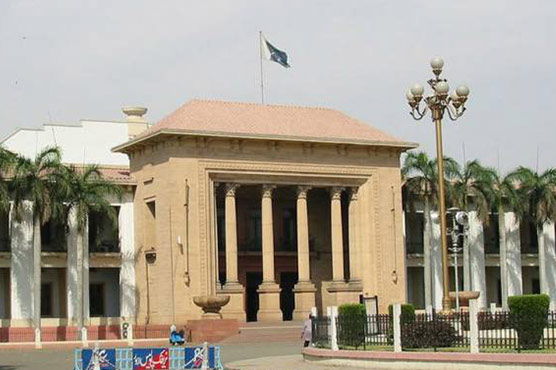
Sept 4, 10am-4pm: Polling day. Elections will take place at Parliament House, Islamabad; Provincial Assembly Building; Lahore, Provincial Assembly Building, Karachi; Provincial Assembly Building, Peshawar; and the Provincial Assembly Building, Quetta.
Election Commission of Pakistan
Tribunals directed to redress complaints within four months.
ISLAMABAD: The Election Commission of Pakistan (ECP) on Wednesday formed 20 special tribunals to address election-related grievances of the politicial parties and their candidates, according to a notification issued here.
Via a notification, the elections regulator stated that high court judges would be presiding the commissioned tribunals. A total of four tribunals have been formed for Sindh, three for Balochistan, eight for Punjab, and five for Khyber Pak0htunkhwa, it said.
Justice Umar Siyal, Justice Yousuf Ali Saeed, Justice Mohammad Shafi Siddiqui, and Justice Khadim Hussain Shaikh from the Sindh High Court will head four tribunals as heads. Justice Hashim Khan Kakar, Justice Abdullah Baloch and Justice Nazeer Ahmed Langove of the Balochistan High Court have been appointed as heads for the three Balochistan tribunals.
Justice Mamoon Rasheed, Justice Shahid Mubeen, Justice Shahid Jameel Khan, Justice Chaudhry Muhammad Iqbal, Justice Muhammad Ameer Bhatti, Justice Sardar Ahmed Naeem, Justice Mujahid Mustaqeem and Justice Waqas Rauf of the Lahore High Court have been appointed to head each of the eight Punjab tribunals.
Justice Musarrat Hilali, Justice Lal Jan Khattak, Justice Muhammad Ghazanfar Khan, Justice Abdul Shakoor Khan and Justice Aijaz Anwar of the Peshawar High Court would head each of the five Khyber Pakhtunkhwa tribunals. The notification said that the tribunals have been directed to redress all grievances of the candidates within four months.
Speaker and Deputy Speaker of the National Assembly
ISLAMABAD: Pakistan Tehreek-e-Insaf (PTI) nominees Asad Qaiser and Qasim Suri were elected respectively as the Speaker and Deputy Speaker of the National Assembly on Wednesday.
Asad Qaiser was contesting against Khursheed Shah from the Pakistan People’s Party (PPP). He received 176 votes whereas Khursheed Shah got 146 votes. A total of 330 votes were cast in the election for the NA speaker, out of which 322 were accepted and eight were rejected.
However, votes of Qasim Suri increased to 183 against 144 votes of Maulana Asad Mehmood, the joint candidate of grand opposition, while out of the 328 polled votes, only one was rejected.
Asad Qaiser was administered oath by outgoing speaker Ayaz Sadiq amid protest and uproar from the parliamentarians of the Pakistan Muslim League-Nawaz (PML-N) and Muttahida Majlis-e-Amal (MMA) gathered in front of the speaker’s dais.
Not immediately welcomed by majority of opposition members, the new speaker occupied his seat but had to suspend proceedings for 15 minutes as the pandemonium being created by the PML-N and MMA members made it impossible for him to go ahead with the election of deputy speaker. The parliamentarians from the Pakistan People’s Party (PPP), however, acted as silent spectators, which reflected a clear divide between the opposition on strategy of protest in the House.
The PML-N parliamentarians accompanied by MMA members gathered in front of the dais while carrying posters of former prime minister Nawaz Sharif captioned ‘Hamara Quaid’. They also raised slogans of ‘Vote Ko Izzat Do’ and ‘Prime Minister Nawaz Sharif’ as the PTI Chairman Imran Khan surrounded by his party members, kept smiling in the meantime.
PML-N President Shahbaz Sharif, Khawaja Muhammad Asif, Rana Sanaullah, Ahsan Iqbal and Murtaza Javed Abbasi gathered in front of the speaker’s dais as former information minister Marriyum Aurengzeb continued to lead the sloganeering. Just two days back, majority of his party leaders suggested that they should play on the front foot in the National Assembly.
Some senior PTI members averted a clash between parliamentarians of the two sides, stopping their colleagues, including Shamim Naqvi to approach the protesting members. Later, the opposition members ended their protest and returned to their seats toof the deputy speaker which completed smoothly.
Earlier, Imran Khan forgot to bring his National Assembly card with him, but Sardar Ayaz Sadiq, who was chairing proceedings, allowed him to poll his vote during speaker’s election.
Later, speaking on a point of order, Abdul Qadar Patel of the PPP, who was polling agent of Khursheed Shah, complained that he also could not bring his ID card and had to go to his accommodation to collect his card. On that, the chair said had he raised the issue before him, he would have been allowed to poll his vote.
The result coming out of election of the deputy speaker was enough to clear the picture ahead of elections of the prime minister scheduled to take place tomorrow (Friday). The result showed that the PTI chairman, who filed his nomination papers on Wednesday for the prime minister’s election, is expected to pocket over 180 votes.
Asad Qasier thanked the members for reposing confidence in him and pledged to live up to their expectations. Addressing the session after taking oath, Asad Qaiser said he will move forward with the consultation of all the elected members. “It is our duty to rise above personal gains and work for Pakistan,” he said.
He observed that the speakership is a big responsibility and that he will do his best to perform his responsibilities in an effective manner. He assured that the elected representatives will be fully facilitated by the staff of the national assembly for legislation.
Asad Qaiser said that the speakership is a big responsibility and he will do his best to perform his responsibilities in an effective manner. He said the elected representatives will be fully facilitated by the staff of the National Assembly for legislation.
He urged the members to play a positive role and work together in the best national interests whilst rising above their personal interests. “Pakistan is our identity and we will have to collectively work for the welfare of the masses,” he said.
During the voting process for the slot of deputy speaker, the PPP lawmaker Shazia Marri on a point of order criticised Asad Qaisar of holding discriminatory attitude towards women parliamentarians. Shazia said the speaker stood up only for male MNAs as they came to vote for the deputy speaker post, but he showed no courtesy to stand up for women who facilitated him on his success. “All parliamentarians are equal in the House irrespective of their gender,” she said.
Asad Qaisar replied to the PPP’s lawmaker that he respects women parliamentarians. The NA speaker started to stand up for the women parliamentarians coming for the vote after objection raised by Shazia Marri.
Two opposition members Roshan Junejo and Najeeb Awaisi did not poll their votes for election of the deputy speaker. Khawaja Asif, Ahsan Iqbal and Dr Darshan filed nomination papers of Shahbaz Sharif for prime minister’s election.
Nisar Mahmood adds from Peshawar: Mushtaq Ahmad Ghani of the PTI was elected as speaker and his party colleague Mehmood Jan as deputy speaker of the Khyber Pakhtunkhwa Assembly on Wednesday.
Mushtaq Ghani got 81 votes, while his rival Laiq Mohammad Khan, associated with the Awami National Party (ANP) and fielded by the joint opposition, managed to secure 27 of the total 108 polled votes. Both belong to Hazara division — Mushtaq Ghani to Abbottabad and Laiq Mohammad to Mansehra.
Mehmood Jan, hailing from Peshawar, obtained 78 votes and was elected as deputy speaker. PML-N’s Jamshed Mohmand, the joint candidate of the opposition elected from Mardan, got 30 votes. For deputy speaker’s contest, 109 votes were polled and one was rejected.
Mushtaq Ghani received five votes more than the actual strength of his party in the assembly, while Mehmood Jan got three extra votes. Nighat Orakzai of the Pakistan People’s Party (PPP), Didar Khan of the PTI and presiding officer Sardar Aurangzeb Nalotha did not cast their votes in the election for the speaker.
However, Nighat Orakzai cast her vote in the election for deputy speaker on the speaker’s request though for some time she refused to cast it as a mark of protest. Didar Khan did not turn up for the deputy speaker’s election as well. Nighat Orakzai entered the assembly hall when the votes had been polled and the presiding officer had ordered the counting of the ballots. She demanded to be allowed to cast her vote, but her request was turned down as the counting of votes had begun.
The shouting and protest that ensued at this stage was countered by shouts of ‘shame shame’ by some lawmakers as well as visitors seated in the galleries.
Aurangzeb Nalotha, who was chosen by KP governor as presiding officer for the opening session, administered oath to the newly elected Speaker Mushtaq Ghani. The speaker later conducted the election for deputy speaker’s office and after the announcement of result administered oath to Deputy Speaker Mehmood Jan.
Mushtaq Ghani is the 18th speaker of the KP Assembly while Mehmood is 22nd deputy speaker. After assuming his office as Speaker, Mushtaq Ghani thanked the assembly members for reposing trust in him and said he would try to run the House in a neutral and unbiased manner. He hinted at making some amendments to the rules of business for smooth and effective running of the assembly proceedings. He maintained that efforts would be made to take both the treasury and opposition benches into confidence on assembly affairs and legislation.
Inayatullah Khan, former senior minister and Jamaat-e-Islami MPA from Upper Dir, lauded Mushtaq Ghani’s election as speaker, saying he was a seasoned and decent politician. He hoped being the custodian of the House he would ensure presence of ministers and bureaucrats in the House to answer the questions raised on the floor.
Congratulating the speaker, Maulana Lutfur Rehman of the Jamiat Ulema-e-Islam-Fazl (JUI-F) hoped he would run the House neutrally. He said the new speaker should ensure debate on issues through arguments.
Sardar Hussain Babak of the ANP also congratulated Mushtaq Ghani and hoped being the custodian of the House he would remove shortcomings from the assembly rules of business. He said the speaker should accommodate the opposition members in the standing committees to ensure better legislation.
Meanwhile, the PPP leader Agha Siraj Durrani was re-elected speaker of Sindh Assembly. With 96 votes, Siraj Durrani defeated the MQM-P’s Javed Hanif (59 votes) to retain his post. The PPP’s nominee Rehana Legahri was elected as the deputy speaker of the assembly. She was contesting against PTI’s Rabia Azfar Nizami for the post. The Balochistan Assembly will elect its speaker and deputy speaker today (Thursday).
Both the assemblies have taken oath from outgoing speakers.
LAHORE (Dunya News) – Election for Speaker and Deputy Speaker of Punjab and Balochistan Assemblies will be held today (Thursday) in Lahore.
Pakistan Tehreek-e-Insaf (PTI) has nominated Chaudhry Parvez Elahi as the coalition’s candidate for post of Speaker Punjab Assembly and Dost Muhammad Mazari as Deputy Speaker.
Pakistan Muslim League-Nawaz (PML-N) has fielded Chaudhry Iqbal Gujjar for post of Speaker and Muhammad Waaris Kallu for Deputy Speaker.
Pakistan Peoples’ Party (PPP) has decided to stay away from the election. Sources told Dunya News that PPP will neither vote for PTI candidate nor for PML-N’s.
On the other hand, the newly-elected members of Balochistan Assembly will also go into secret balloting for selection of speaker and deputy speaker.
The session of the Balochistan Assembly is scheduled to begin at 03:00PM today.
Balochistan Awami Party (BAP) has nominated Abdul Quddus Bizenjo for the slot of speaker while Sardar Babar Musakhel of PTI will be the joint candidate of the alliance for the job of deputy speaker.
The nomination papers for the aforementioned slots can be submitted till 11:00AM today.
Pakistan Peoples Party (PPP) Agha Siraj Durrani on Wednesday retained his post as Sindh Assembly speaker while Rehana Leghari was elected deputy speaker.
Durrani received 96 votes against Muttahida Qaumi Movement-Pakistan’s Javed Hanif, who received 59 votes.
The PPP had submitted nomination papers for Durrani as the speaker and Rehana Leghari as the deputy speaker in the provincial assembly.
The election of the deputy speaker commenced after Durrani took oath of the office.
Rehana Leghari defeated Pakistan Tehreek-e-Insaf’s Rabia Azfar Nizami for the slot of deputy speaker of the provincial assembly. The elections for the two posts were held through secret balloting by 165 elected members of the 168-member House. Nadir Magsi, a PPP MPA, conducted the election as the presiding officer.
Pakistan Tehreek-e-Insaf has grabbed both the slots of Speaker and Deputy Speaker in the Khyber Paktunkhwa Assembly.
PESHAWAR: Pakistan Tehreek-e-Insaf has grabbed both the slots of Speaker and Deputy Speaker in the Khyber Paktunkhwa Assembly.
Mushtaq Ghani and Mehmood Jan, who were nominated for the posts of Speaker and Deputy Speaker, were elected with heavy margin.
Ghani secured 81 votes in the house of 124.
In the Khyber Pakhtunkhwa Assembly, the PTI has increased its seats share to 64 members after the inclusion of two independent members in the party’s fold. With the numbers in hand, the party has taken its seat total to 84 seats after addition of 16 women and two minority seats.
The MMA is at the distant second with 13 seats including 10 general seats, two women, and a minority reserved seat.
ANP secured a nine-member representation with seven members on general seats and two seats on women reserved seats.
The PML-N won five general seats, and with the addition of one women reserved seat, its tally stands at six in the provincial assembly. The PPP with four general seats and one women reserved sear stands with the total of five seats.
The 15th National Assembly will resume its session at 10 am today elect its Speaker and Deputy Speaker.
The majority party in the House, Pakistan Tehreek-e-Insaf has nominated Asad Qaisar for the slot of the Speaker while Syed Khurshid Shah has been named by the joint opposition for it.
For Deputy Speaker, PTI has fielded Qasim Suri while the joint opposition has nominated Muttahida Majlis-e-Amal leader Asad Mahmood.
Sindh Assembly will also elect the Speaker as well as deputy through secret balloting on Wednesday.
Nomination papers of Agha Siraj Durrani of PPP and Javed Hanif of MQM-Pakistan have been accepted for the post of Speaker.
Rehana Leghari of Pakistan Peoples Party and Rabia Azfar Nizami of Pakistan Tehreek-e-Insaf are contesting for Deputy Speakership.
According to Provincial Assembly Secretariat, election for the two posts will be held through secret balloting by 165 elected members of the 168 member house.
Khyber Pakhtunkhwa Assembly members will elect Speaker and Deputy Speaker today.
Pakistan Tehreek-e-Insaf has nominated Mushtaq Ahmad Ghani for Speaker and Mehmood Jan for the slot of Deputy Speaker.
Laiq Muhammad Khan of Awami National Party is contesting for the slot of Speaker, while Jamshaid Khan of PML (N) has been nominated for Deputy Speaker post by the joint opposition.
Chaudhry Nisar was not present during the ceremony
Elections for speaker, deputy speaker to take place on August 16
LAHORE: The newly elected MPAs took the oath of their offices in the inaugural session of the Punjab Assembly on Wednesday. The ceremony was administered by outgoing Punjab Assembly Speaker Rana Iqbal.
Chaudhry Nisar was not present at the ceremony.
Elections for the slots of Speaker and Deputy Speaker of the Punjab Assembly will take place on August 16, after which the new chief minister will be elected through secret balloting.
Pakistan Muslim League-Nawaz (PML-N) has nominated Hamza Shehbaz for the slot of Punjab chief minister. Its rival, the Pakistan Tehreek-e-Insaf (PTI), has yet to name its candidate for the position.
PML-N has also nominated Chaudhry Iqbal Gujjar as Punjab Assembly’s speaker candidate.
Speaking to reporters outside the Punjab Assembly, Hamza Shehbaz took a jibe at rival PTI and said, “The public would see over the next years what changes they bring under Naya Pakistan.”
“People don’t view politics based on [personal gains] favourably,” he said and vowed his party would offer a strong-footed opposition.
In the 371-member Punjab Assembly, the PTI is leading with 179 seats followed by the PML-N with 164 seats, the PML-Q with 10 seats and the PPP with seven seats. There are four independent candidates in the provincial legislature. At least 186 votes are required to win the chief minister, speaker and deputy speaker slots.
Elections were postponed in three constituencies and results of another three are withheld due to pending litigation. There are 66 reserved seats for women and eight for non-Muslims in the provincial legislature.
The PTI had won 119 seats through direct election, while 23 MPAs joined it later. Now on the basis of its 142 seats, it has been allocated 33 women’s seats and four non-Muslim’s seats.
The PML-N had won 129 seats while one independent candidate had joined it later. It has been allocated 30 women and four non-Muslim seats.
The PML-Q won seven general seats while one independent candidate joined it later. It has been allocated two women reserved seats. The PPP had won six general seats and one women seat has been given to it.
On Monday, the inaugural session of the KP Assembly commenced with PML-N leader Sardar Aurangzeb Nalota presiding over the swearing-in ceremony. Nalota was appointed by the K-P governor after Asad Qaiser took the oath in the National Assembly.
After an uncalled delay, the first session of the 11th Balochistan Assembly commenced with 62 of 65 members taking the oath. Speaker Rahila Hameed Khan Durrani administered the oath to the newly-elected members.
Sindh Assembly MPAs also took oath on Monday. Speaker Agha Siraj Durrani administered the oath to 165 members on the occasion.
PTI chairman Imran Khan and other lawmakers take oath. — Photo courtesy: NA Secretariat
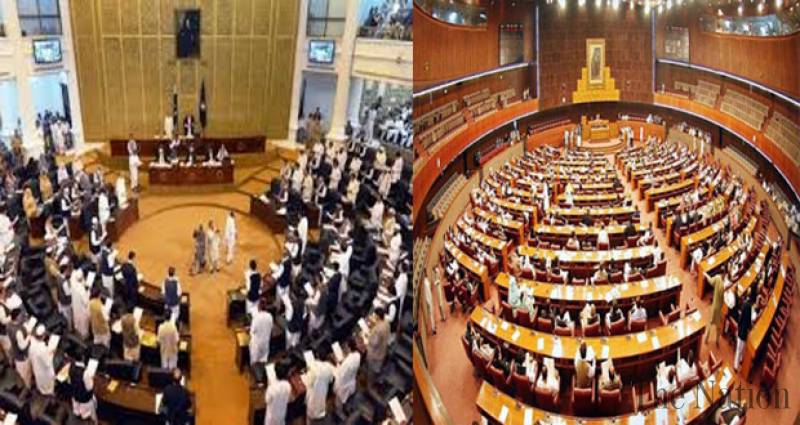
The first session of the 15th National Assembly ended on Monday after 329 members of the lower house of the parliament took oath following their election in the July 25 countrywide polls.
Outgoing NA Speaker Ayaz Sadiq administered the oath to the MNAs-elect in the 342-member house, in what is a part of only the second democratic transition in the country’s history.
Prime minister-in-waiting and Pakistan Tehreek-i-Insaf (PTI) chairman Imran Khan and other prominent political leaders, including PML-N president Shahbaz Sharif, PPP chairman Bilawal Bhutto-Zardari and former president Asif Ali Zardari, were present in the assembly for the oath-taking.
TV footage showed the PTI chief shaking hands and posing for a photo with Bilawal, who is entering NA for his maiden term.
Imran Khan arrives at NA.
The session commenced with the MNAs-elect standing up for the national anthem. This was followed by the recitation of the Holy Quran.
The speaker then read out the procedure for the election of the new speaker and deputy speaker.
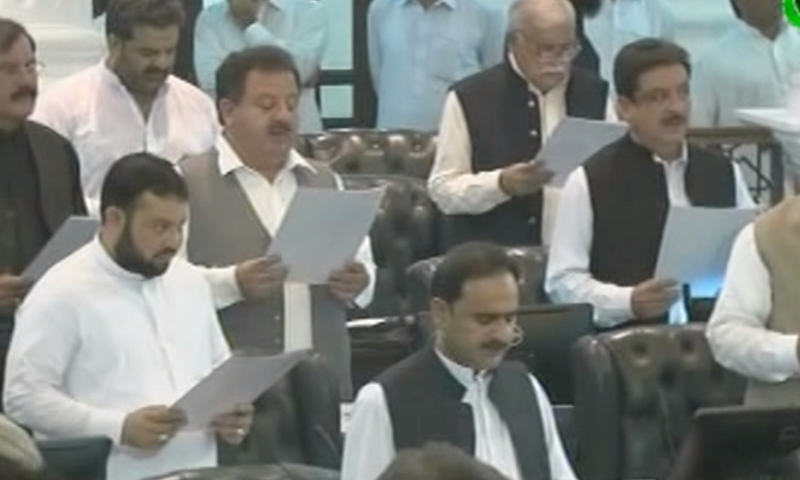
The MNAs-elect then stood up as Sadiq administered the oath of office to them. The MNAs were then asked to proceed to the speaker’s desk to sign the roll of members. Being first in the alphabetical order, PPP co-chairman Asif Zardari was the first to be called to sign the roll.
MNAs take oath.
After completion of the swearing-in ceremony, the speaker prorogued the NA session until 10am on August 15, when the new speaker and deputy speaker of the assembly will be elected. The nomination papers for the same will be submitted by noon tomorrow.
Strict security measures were taken to avoid any untoward incident during the proceedings and irrelevant persons had been barred from entering the house.
Sessions were also held in the provincial assemblies of Sindh, Khyber Pakhtunkhwa and Balochistan, where MPAs-elect took oath of office. The oath-taking ceremony for MPAs-elect of Punjab Assembly will take place on August 15.
Bilawal Bhutto Zardari and Imran Khan meet.
The PTI has already nominated former speaker of Khyber Pakhtunkhwa Assembly Asad Qaiser for the office of NA speaker and he would face Syed Khursheed Shah of the PPP, a joint candidate of the 11-party alliance, Pakistan Alliance for Free and Fair Elections.
Similarly, PTI chairman Imran Khan will be contesting against PML-N president Shahbaz Sharif for the office of the prime minister.
KP Assembly takes oath
Members of KP Assembly take oath.
A session was held in Khyber Pakhtunkhwa Assembly, where 111 MPAs took oath in the 124-member house.
PML-N MPA-elect Sardar Aurangzeb Nalotha, who was nominated by KP Governor Iqbal Zafar Jhagra as the presiding officer, administered the oath to the new members of the provincial assembly.
Members of Muttahida Majlis-e-Amal, PPP and Awami National Party, who were wearing black bands on their arms, staged a symbolic walkout during the oath-taking over the terrorist violence that preceded the July 25 elections. They re-entered the assembly after the walkout and were administered the oath separately.
The session was subsequently adjourned indefinitely.
Sindh MPAs take oath
Sindh Assembly members take oath.
Outgoing Speaker Agha Siraj Durrani administered the oath to 165 MPAs-elect of the Sindh Assembly in Urdu, Sindhi and English.
The session was adjourned after all members signed the roll of members.
Apart from 38 reserved seats for women and religious minorities, the provincial legislature has 130 general seats.
Tanzeela Qambrani, the first Sindhi Sheedi woman to become an MPA, arrives to take oath.
The Election Commission of Pakistan has notified the results of 127 seats as the results of two constituencies are still awaited, while the election on PS-87 (Malir-I) was not held because of the death of a contestant.
Balochistan MPAs take oath
Outgoing speaker Raheela Hameed Khan Durrani administered the oath to 60 incoming members of the 11th Balochistan Assembly.
Four MPAs, including Mir Naseebullah Marri, took oath as a lawmaker for the first time.
The members also offered fateha for the people slain in terrorist incidents in the province in the run-up to the elections.
Sanaullah Zehri, who was elected as an MPA for the seventh time, did not turn up for the oath-taking ceremony.
The speaker adjourned the session after the oath-taking of the newly elected members.
Composition of new NA
After the issuance of notifications of the returned candidates on the reserved seats for women and minorities by the Election Commission of Pakistan (ECP) on Saturday, the PTI has 158 members in the National Assembly.
The PTI’s tally has reached 158 members after the joining of nine independents and bagging 33 seats reserved for women and minorities.
Out of the 60 reserved women seats, the PTI has clinched 28, followed by the Pakistan Muslim League-N (PML-N) with 16 seats, Pakistan Peoples Party (PPP) nine seats, Muttahida Majlis-i-Amal (MMA) two seats and one seat each by Balochistan Awami Party (BAP), Balochistan National Party (BNP), Grand Democratic Alliance (GDA), Muttahida Qaumi Movement (MQM) and Pakistan Muslim League-Q (PML-Q).
MNAs stand up for national anthem.
Similarly, out of the 10 reserved seats for minorities, the PTI has won five, followed by two each by the PPP and PML-N and one by the MMA.
If the votes of the PTI and its allied parties are counted, the total comes to 184 in the house of 339. In addition to this, four independent MNAs-elect are also poised to support the PTI and, therefore, the total number of the members belonging to the PTI and its allies comes to 188. But the PTI will still not be facing a weak opposition as the strength of its arch-rival PML-N and its allies also comes to 151.
The PML-N with 82 seats is the largest party in the opposition group, followed by PPP (53 seats); MMA (15 seats) and ANP (one seat).
SC allows notification of NA-215 poll to be issued
Also on Monday, the Supreme Court suspended a Sindh High Court order restraining the Election Commission of Pakistan (ECP) from notifying the results pertaining to the unofficially declared winner of NA-215 Sanghar-I.
A three-judge bench headed by Chief Justice Saqib Nisar allowed the commission to issue the notification of victory of PPP’s candidate Naveed Dero
The high court had issued the restraining order on a petition filed by Grand Democratic Alliance candidate Khuda Bux Rajar.
KARACHI: The Election Commission of Pakistan (ECP) on Wednesday uploaded all forms containing key data of the July 25 general election results on its website, the same day opposition parties held a protest demonstration outside its office in Islamabad against alleged rigging in the polling process.
A day ago, the Commission had notified the final results of the general election but withheld results of nine national and 17 provincial assembly seats for various reasons, stirring a new controversy before the formation of the next government.
Election day itself was marred by controversies as a number of political parties had cried foul that their political agents were not issued Form-45 ‘Result of the Count’, implying possible attempts at rigging.
The delay in announcement of results had irked losing candidates as the ECP announced failure of the result transmission system (RTS) on the election night, casting further doubt on the transparency of electoral process.
According to Section 95 (8) of the Elections Act 2017, “The Returning Officer shall, within 24 hours after the consolidation proceedings, send to the Commission signed copies of the consolidated statement of the results of the count and final consolidated result together with results of the count and the ballot paper account, as received from the Presiding Officers, and shall retain copies of these documents for record.”
As per Section 95 (10), the ECP is required to place within 14 days from polling day the documents received from Returning Officers on its website.
Two weeks after polling day, the ECP on Wednesday uploaded all the required documents pertaining to the election results.
Available on the ECP’s website, the Form-45 — previously Form-14 — contains essential data of each polling station of a constituency of the national or provincial assemblies.
For the first time in the country’s electoral history, the form provides gender-wise disaggregated data of votes cast at a polling station. The form also contains a list of names of contesting candidates, the number of valid votes polled in favour of each candidate, the number of valid tendered votes polled in favour of each candidate and the number of valid challenged votes polled in favour of each candidate and total number of valid votes polled in favour of each candidate as well as the number of votes excluded from the count.
The second form prepared by the Presiding Officers and uploaded on the website is Form-46 ‘Ballot Paper Account’ showing the number of ballot papers received, un-issued, taken out of the ballot boxes, tendered, challenged and spoilt.
The data also includes Form-47 ‘Provisional Consolidated Statement of Results’ which is the provisional consolidated statement of results of the count (excluding postal ballots) of the constituency, as required under Section 92 of the law.
Province-wise Forms-48 and -49 are available on the website as well. Form-48 ‘Consolidated Statement of Results of the Count’ is furnished by the Presiding Officers and contains details about the votes polled per polling station of a constituency. Form-49 ‘Final Consolidated Results’ shows the name of contesting candidates, their party affiliation if any, and the number of votes received.
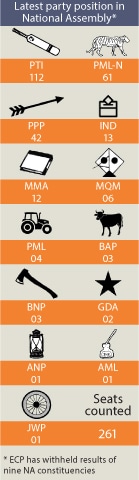
ISLAMABAD: The Election Commission of Pakistan (ECP) on Tuesday notified the final results of the general election but withheld results of nine national and 17 provincial assembly seats for various reasons, stirring a new controversy before the formation of the next government.
The strength of the Pakistan Tehreek-i-Insaf (PTI) in the National Assembly has gone down from 116 to 112 for now and its ally Balochistan Awami Party from four to three.
The nine NA constituencies where the results have been withheld include NA-53 (Islamabad) and NA-131 (Lahore) from where prime minister-in-waiting Imran Khan had defeated former PM Shahid Khaqan Abbasi and former minister Khawaja Saad Rafique, respectively.
Even the notifications of Mr Khan’s victory from NA-35 (Bannu), NA-95 (Mianwali-I) and NA-243 (Karachi East-II) have been issued conditionally. “The notification shall be subject to the final decision of the Election Commission in the pending case of violation of code of conduct,” a note attached with all the three notifications read.
Issues conditional results of Imran’s victory from three constituencies, withholds notification of two other seats
Though the note did not explain the nature of the violation, it apparently referred to the violation of secrecy of vote by stamping the ballot paper in the NA-53 (Islamabad) constituency on the table of presiding officer, instead of going behind the voting screen.
The development related to the issuance of condition notifications of Mr Khan’s victory generated a debate on whether he would be able to form a government at the Centre.
In all, the PTI had won on four out of the nine NA seats where the results have been put on hold.
Three of the nine seats had been claimed by the Pakistan Muslim League-Nawaz and one each by the Pakistan Peoples Party and the BAP.
This has reduced the strength of the PTI in the NA to 112, followed by the PML-N (61) and the PPP (42). The strength of the BAP has gone down to three.
The notifications of seven of the nine constitutions have been withheld pursuant to orders of the high courts. These include NA-131 (Lahore) constituency, where Mr Khan won against Khawaja Saad Rafique; NA-108 constituency where PTI’s Farrukh Habib defeated PML-N’s Abid Sher Ali; the NA-140 (Kasur) constituency, where PTI’s Sardar Talib Nakai defeated Rana Mohammad Hayat Khan; NA-90 and -91 (Sargodha) where PML-N’s Hamid Hameed and Zulfiqar Ali Bhatti emerged victorious, NA-112 (Toba Tek Singh) seat which was won by PML-N’s Junaid Anwar Chaudhry; and NA-215 (Sanghar) seat that was won by PPP’s Naveed Dero. Result of NA-271 (Kech) has been withheld for failure of BAP’s Zubeda Jalal to submit return of her election expenses.
Elections had taken place on 270 of the total 272 general seats in the National Assembly. Elections in NA-60 (Rawalpindi) constituency had been postponed after the disqualification of PML-N leader Haneef Abbasi only days before the general election, while polls in Faisalabad had been postponed after the death of a contesting candidate.
Of the total 297 seats in the Punjab Assembly, elections were held on 295 seats. In PP-87 and PP-103 constituencies, elections had been postponed after the death of contesting candidates. The ECP declared final results of 290 PP seats.
A notification has not been issued for PP-296 (Rajanpur) as the PTI’s winning candidate died after his victory. In the remaining four constituencies, results have been withheld on orders of the Lahore High Court. The PTI and the PML-N had won two seats each of them.
While elections took place on 129 of the total 297 general seats of the Sindh Assembly, the ECP withheld results of six of them. The Grand Democratic Alliance and the PPP had won three seats each from these constituencies.
The notification of PS-73 where PPP’s Taj Mohammad defeated GDA’s Fehmida Mirza has not been issued, as the ECP awaits result from the returning officer after recount.
However, the results of PS-29 (Khairpur), PS-36 (Naushahro Feroze), PS-46 (Mirpurkhas), PS-54 (Tharparkar) and PS-82 (Jamshoro) have been withheld owing to stay order of the Sindh High Court.
Of the total 99 general seats of Khyber Pakhtunkhwa Assembly, polls had been held on 97 seats while the results of three of them have been withheld. The PTI had claimed victory on all the three seats.
PTI’s Azizullah Khan had won from the PK-4 (Swat) constituency and the result has been withheld for want of vote recount. PTI’s Shaukat Ali had won PK-23 (Shangla) seat, while the ECP withheld its result for unexplained reason. PTI’s Haji Qalandar Khan had won the PK-38 (Abbottabad) seat whose notification has been withheld on the Peshawar High Court order.
Results of three constituencies of Balochistan Assembly have also been withheld. Ahmad Alki of Hazara Democratic Party had claimed victory in PB-26 (Quetta) constituency whose result was withheld by the ECP for unexplained reasons. The notification of independent candidate Mir Niamatullah Zehri’s victory had been withheld for his failure to meet the mandatory legal requirement of submitting return of election expenses.
The result of another winning candidate Zahid Ali from PB 41 (Washuk) had not been notified for unexplained reasons.
The PTI has pleaded the chief justice of Pakistan (CJP) to take notice of the withholding of results by the Election Commission and the delay caused by the orders of subordinate courts.
While expressing serious reservations over the delay of election results, PTI central secretary information Fawad Chaudhary said smooth transition of power was a matter of serious concern. “Any sort of delay will directly affect the country and masses,” he said.
Terming the delay harmful, the PTI leader stated that it would cast doubts on the whole electoral process. Therefore, he requested the CJP to personally take notice of the delay caused by the ECP and the subordinate courts.
ISLAMABAD: In what marks the commencement of a formal process for formation of new governments at the Centre and in the provinces, the Election Commission of Pakistan (ECP) is all set to notify final results of the general election on Tuesday (today).
The notification will meet a legal deadline for declaration of results set under Section 98 of the Elections Act.
“On receipt of the final consolidated result from the returning officer, the commission shall, within 14 days from the date of the polls, publish in the official gazette the name of the contesting candidate who has received the highest number of votes and stands elected,” Section 98 (1) reads.
Under Section 98 (2), the ECP is also to publish in the official gazette the name of each contesting candidate and the total number of votes received by him as in the final consolidated result.
Independent members-elect to have three more days to join any party
The ECP under the law will be required to place the documents on its official website within two days from the date of publication of the name of returned candidate in the official gazette.
A senior ECP official told Dawn that the independent members-elect of the national and provincial assemblies would have three more days to join a political party.
According to him, if a member is elected to the National Assembly as an independent, Article 51(e) provides that the member can join a party within three days after his name is published in the official gazette as a winner.
A similar provision is given in Article 106 of the Constitution for provincial assembly members.
Immediately after the announcement of official results of the national and provincial assemblies, the ECP issues a notification giving those elected as independents an option to join a political party. If they don’t join a party within the specified timeframe, such members are treated as independents.
The official said on the basis of the number of independents joining political parties, the ECP would calculate each party’s share in the seats reserved for women and religious minorities and would notify the names of members to be declared successful for reserved seats on Aug 11.
Later, he said, the president would summon the National Assembly session to meet within next two days — most probably on Aug 13. He said members-elect would take oath of their office during the maiden session followed by election to the offices of speaker and deputy speaker. He said election for the coveted office of prime minister would most likely take place on Aug 15.
Answering a question, the official said the schedule for presidential elections would be announced by the ECP shortly after the first sessions of the national and provincial assemblies.
The constitutional five-year term of President Mamnoon Hussain will end on Sept 9. Under the Constitution, the election to the office of the president should take place not earlier than two months before and not later than one month before expiration of his term, but a schedule could not be announced in the absence of the president’s electoral college comprising the national and provincial assemblies besides the Senate.
The official said the delay in the announcement of the schedule owing to legal and procedural hitches would not make any difference, as the process of polls would be completed much before expiry of the president’s term.
ISLAMABAD: The deadline for the newly elected candidates to submit the details of their election expenses ended at midnight.
“The winning candidates should submit their election expenses to the returning officers concerned for issuing of official notification,” said the ECP in a statement. All successful candidates are bound to submit the details of their election expenses within 10 days of polling, while unsuccessful candidates are required to submit their expenditure details within 30 days.
The commission will issue official notifications of successful candidates after receiving the expenses details. The notifications of successful candidates who fail to share their expense declarations will be withheld.
After the successful candidates are notified, the independent candidates will have three days to join any party.
The strength of all political parties in the national and provincial assemblies will be determined after the inclusion of independent candidates, after which the ECP will notify successful candidates from reserved seats. It is the constitutional obligation that the new assembly session should be convened within 21 days after elections so that the election of new prime minister, speaker and deputy speaker might be carried out.
The candidates who have won the elections from more than one constituency must retain only one seat within three days of the notification.
PESHAWAR: The complete result of NA-39 Dera Ismail Khan where Muttahida Majlis-e-Amal (MMA) chief Maulana Fazlur Rahman was defeated by Mohammad Yaqub Sheikh of the Pakistan Tehreek-e-Insaf (PTI) was uploaded on the official website of the Election Commission eight days after the polling on Thursday.
Earlier, the results of only 23 polling stations of the total 312 had been compiled and uploaded on the website, declaring Maulana Fazlur Rahman as the losing candidate.
According to the spokesman for the Jamiat Ulema-e-Islam-F (JUI-F) Abdul Jalil Jan, this was enough to show the desperation of certain quarters to keep Maulana Fazlur Rahman away from the Parliament.
According to the complete results, Sheikh Yaqub secured 79,332 ballots against 52,031 polled by Maulana Fazlur Rahman. The voter turnout was shown as 50.59 percent.
According to the results of 23 polling stations, which were projected earlier, the MMA leader had secured 4,076 ballots while the winning candidate Mohammad Yaqub Sheikh had received 5,516 votes.
It had been stated in the Form-47 earlier that 11,303 voters out of the total 328,428 had cast votes. The turnout projected earlier was 3.4 percent.
Abdul Jalil Jan told The News that the Election Commission had badly failed to ensure transparency in the election. He alleged that the results had been prepared even before the day of the polling, July 25, in some constituencies and uploaded on the Election Commission’s website.
The JUI-F spokesman said they had reported it to the Election Commission as well as the returning officers but no action was taken on their complaints.
He claimed that the election had been massively rigged and the results engineered.
Meanwhile, former chief minister and JUI-F leader Akram Khan Durrani requested the party chief Maulana Fazlur Rahman to contest by-election from NA-35 Bannu, which is expected to be vacated by Pakistan Tehreek-e-Insaf (PTI) chairman Imran Khan.
According to the party spokesman, Akram Durrani and other leaders of the party wanted Maulana Fazlur Rahman to contest the by-election. However, they added that it is up to Maulana Fazlur Rahman to accept the request or reject it.
Maulana Fazlur Rahman had contested the general election on two National Assembly seats from Dera Ismail Khan – NA-38 and NA-39 – but was unsuccessful on both seats. In NA-38, he was defeated by PTI’s former provincial minister Ali Amin Gandapur.
Awami National Party (ANP) candidate Khush Dil Khan secured victory from PK-70 Peshawar after a vote recount on Thursday.
“The vote recount showed Khush Dil Khan’s lead with a margin of 187 votes,” the returning officer said.
During the July 25 polls, Pakistan Tehreek-e-Insaf’s Shah Farman had emerged winner with a mere 47 vote difference over Khan. However, the ANP candidate had sought a recount in the constituency.
Shah Farman was former provincial minister and also won from PK-71 in the 2018 General Election.
Khush Dil Khan had previously served as KP Assembly deputy speaker.
After the vote recount, ANP’s position in the KP Assembly stands at seven seats as opposed to PTI’s 65 seats.







 ISLAMABAD: The Election Commission of Pakistan (ECP) on Tuesday notified the final results of the general election but withheld results of nine national and 17 provincial assembly seats for various reasons, stirring a new controversy before the formation of the next government.
